Proof of readiness
A vehicle may only operate at RobotX 2026 after its readiness submission has passed. Handbook section 3.1 asks for a recorded autonomous run per domain, drawings and photographs of the safety systems, and a log of a run start sequence. This page lists what we submitted and the evidence for it.
Status
Submissions are reviewed on a rolling basis and marked pass or fail. A failed submission can be resubmitted until the window closes. The mandatory window for a surface vehicle plus one other domain closed on 31 August 2026; the optional third system closes on 12 October 2026.
| Submission | Handbook | Contents | State |
|---|---|---|---|
| Surface vehicle | 3.1.2 | Autonomous gate run, kill switch drawings, tow and lift points, shrouds, control block diagram | Submitted |
| Underwater vehicle | 3.1.3 | Submerged gate run, kill switch drawing, tow and lift points, shrouds, beacon mounting, buoyancy | Submitted |
| Aircraft and pilot | 3.1.4 | Information package, manual and autonomous flights, safety behaviour, controller compliance | Submitted |
| Communications | 3.1.5 | RF emitter worksheet and a run start log from RoboNation's test server | Submitted |
The full requirement list has 63 items across 3.1.1 to 3.1.5. We track all of them in the rehearsal tool below. It marks the items a rehearsal can judge; the rest are documents and photographs that a team member has to produce.
Surface vehicle, 3.1.2
The demonstration is a fully autonomous run that starts 3 m behind the gate, passes through both sets of gates without striking a buoy, and shows steady control throughout. The uploaded documents are the kill switch wiring, the marked tow and lift points with their harness, the propeller shrouds, and a block diagram showing that manual control works with the laptop switched off.
The 3.1.2 course built to the handbook's dimensions. The gate crossings, the clearance to the nearest buoy and the vehicle mode are checked during the run.
Underwater vehicle, 3.1.3
The run starts 3 m behind a 2 m gate hung 1 m below the surface. The vehicle submerges, passes under the gate, circles a marker 10 m beyond it and returns through the gate, without breaching and without anything attached to it floating on the surface.
Depth is drawn as a column from the hull to the surface. It turns red if the vehicle comes within 0.3 m of the surface. The turn around the marker is drawn as it happens, with a caption showing the degrees completed.
Aircraft and pilot, 3.1.4
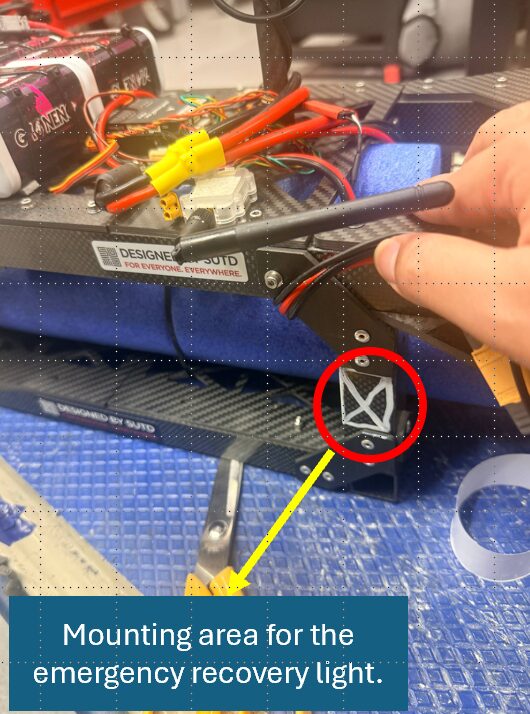
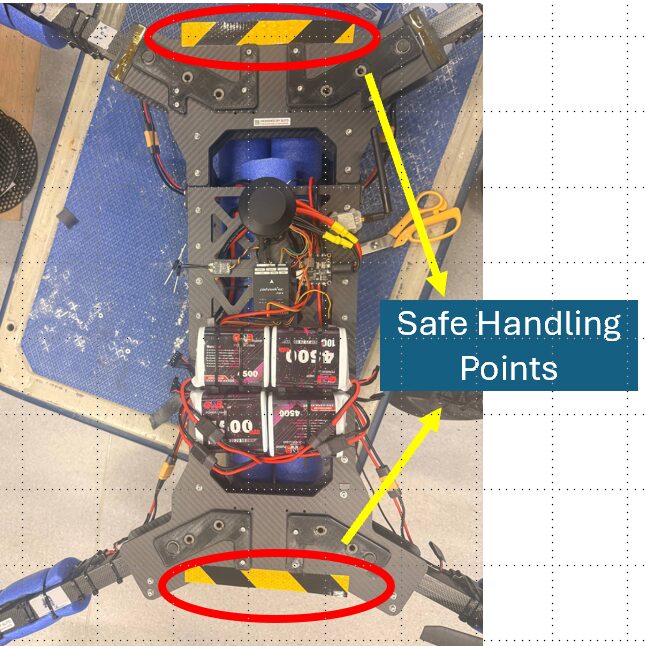
The aircraft package is the largest of the four. It contains an information package for airframe and pilot review and a flight demonstration in both manual and autonomous modes with mode proof: a takeoff above 3 m, the published pattern, geofence and ceiling compliance when commanded past them, and a landing. It also documents the safety systems: the emergency recovery light mounting area, the marked handling areas, the behaviour on link loss, low battery, mission abort and geofence, and the dedicated controller.
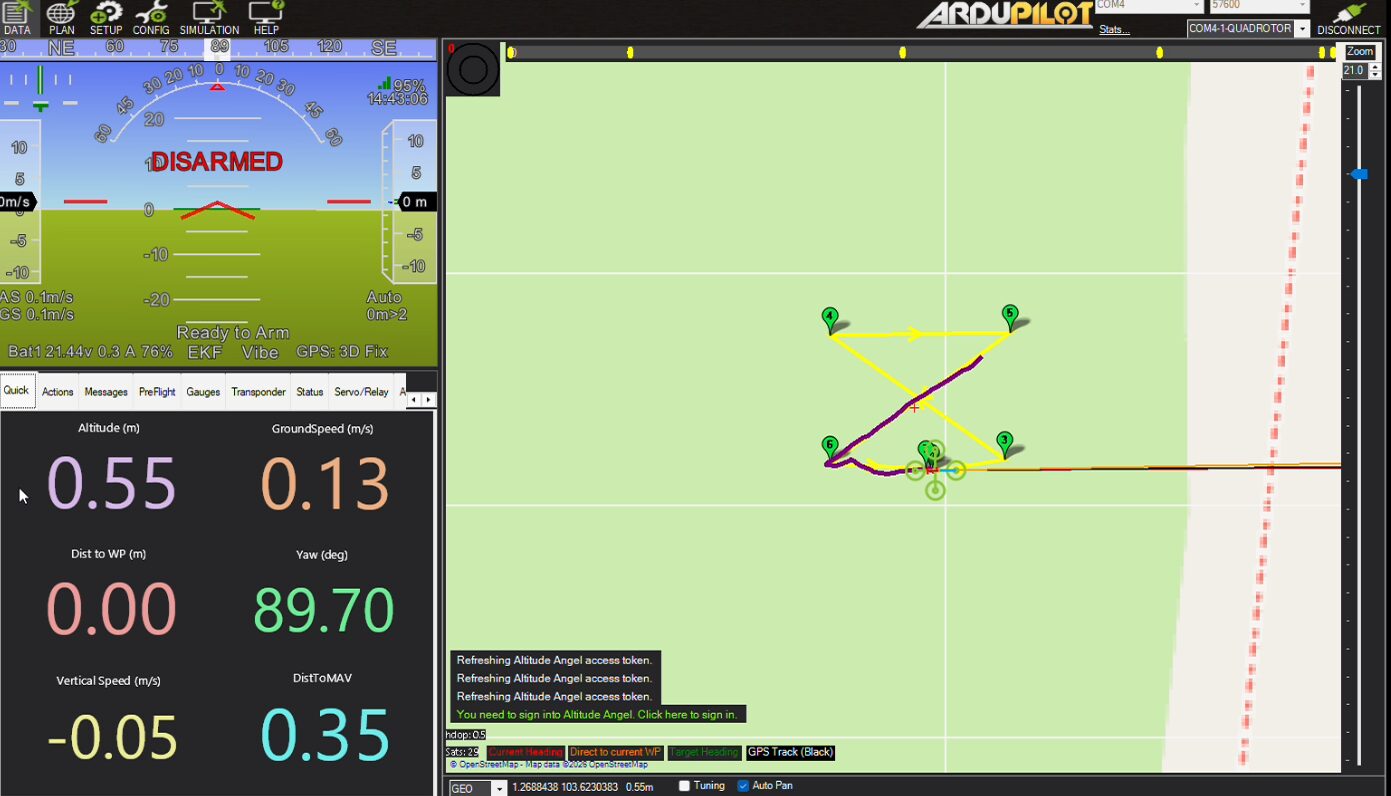
The rehearsal flies both modes, then commands the aircraft 15 m past the fence and 20 m above the ceiling. The criterion passes only if the aircraft is seen to hold at the limit. The submitted video has to show this.
The flight videos are on the aircraft page: manual, autonomous, geofence, link loss and buoyancy.
Communications, 3.1.5
This submission has two parts: the RF emitter worksheet for every radio we bring, and logs showing a run start sequence per handbook 3.4.10 with at least two vehicles in the declaration. We ran the sequence against RoboNation's rc-test server, so the submitted log was written by their code while decoding our traffic against their schema.
| Step | What happens | Evidence |
|---|---|---|
| 1 | Console connects to the course broker | One MQTT connection carrying every subscription and publication |
| 2 | Console subscribes to the course and command topics | Implied by step 3: the retained course could not arrive otherwise |
| 3 | Course configuration received and validated | Course ALPHA, pinger 25 kHz, five point closed boundary |
| 4 | Run declaration published | Sequence 1, three vehicles, a tier per task, a five point aerial geofence |
| 5 | Heartbeats for every declared vehicle | 2 Hz per vehicle while the fleet is held in manual |
| 6 | Each vehicle reports autonomous | All three transition once armed and holding position |
| 7 | RoboCommand publishes the run start | Released on the third autonomous report: run 1, declaration sequence 1 |
| 8 | Console verifies the declaration sequence | Matched against what we sent. A run start quoting anything else is logged and ignored |
The console output from that run:
16:25:38 | INFO    | RoboCommand connected: team=SUTD
16:25:38 | INFO    | RoboCommand: course ALPHA pinger=25000 Hz boundary=5 points
16:25:38 | INFO    | RoboCommand: RunDeclaration seq=1 vehicles=USV1,UUV1,UAV1
16:25:49 | SUCCESS | RoboCommand: RunStart run_id=1 declaration_seq=1 verified

  PASS  MQTT connection
  PASS  retained RxCourse received
  PASS  RunDeclaration published
  PASS  at least two vehicles declared
  PASS  RunStart received
  PASS  RunStart quotes declaration_seq=1
Run 1 started on course ALPHA
The log also shows the details of 3.4 that are easy to get wrong: per vehicle sequence counters independent of the team request counter, complete heartbeat telemetry including the flight phase for the aircraft, the correct vehicle type in each topic segment, and a declared tier for every task instead of an unknown value.
Rehearsal tool
Each readiness course is specified in the handbook to the metre and takes time to build. We built all four in the simulator and fly each demonstration there before we film it. Every criterion shows the rule it applies and the value it measured, so each pass is based on a measurement.
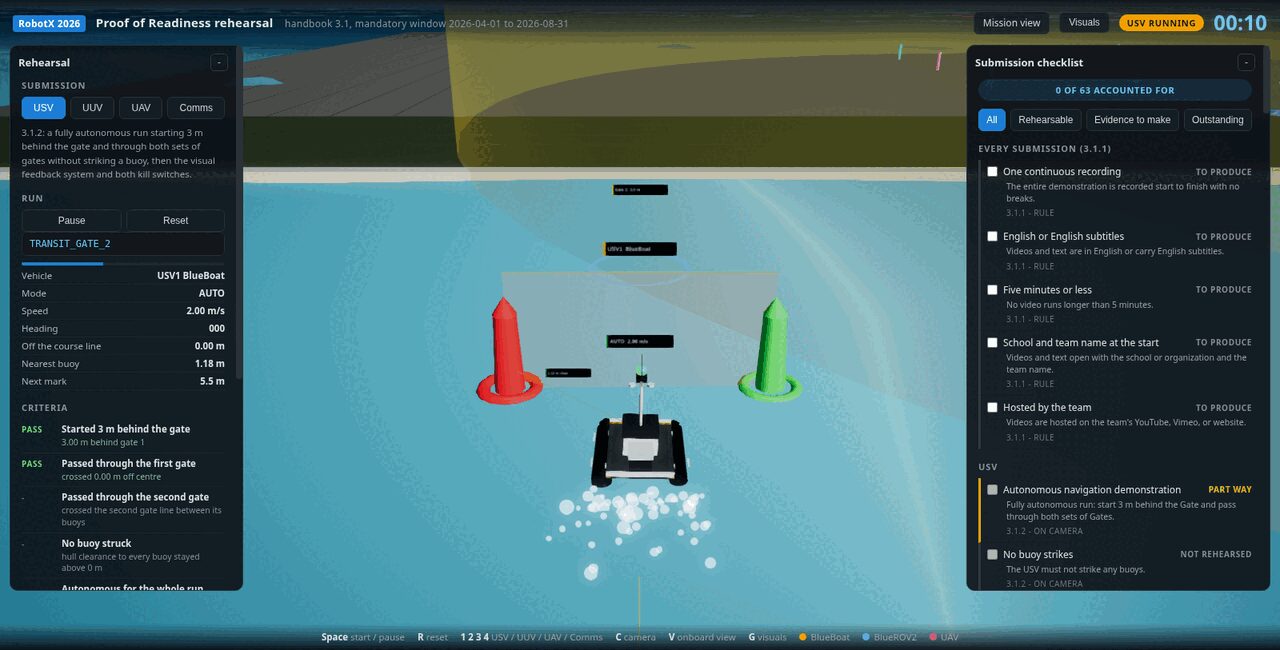
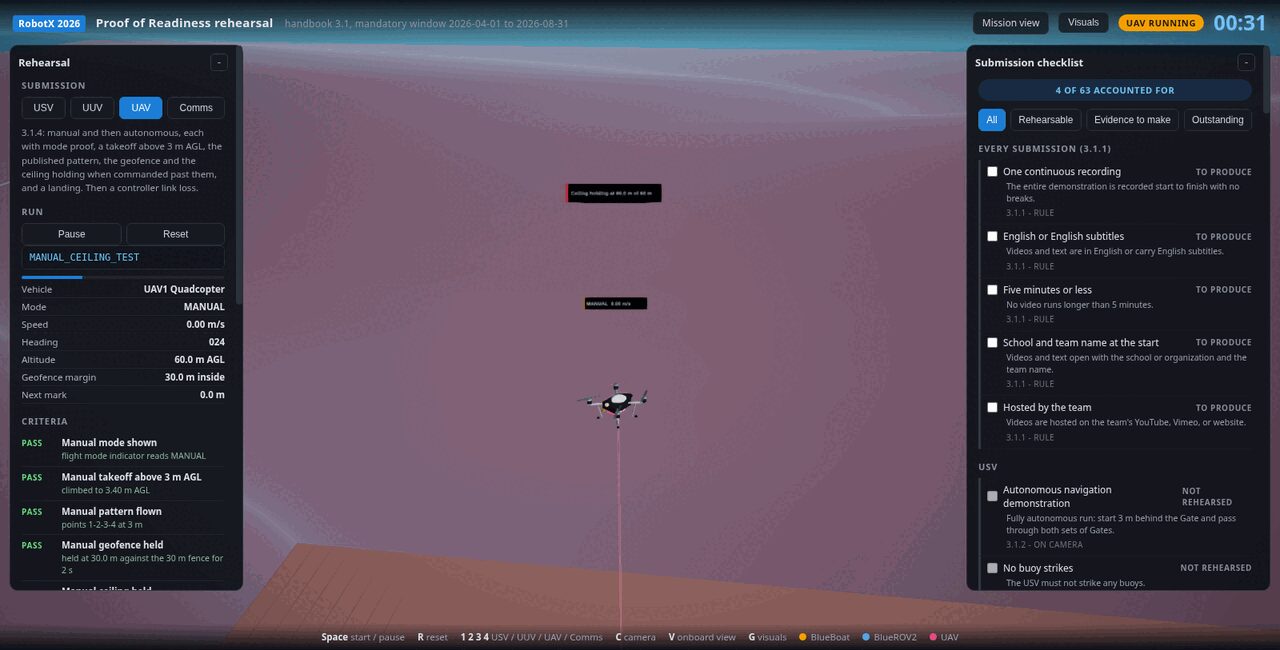
The checklist on the right of that page lists all 63 requirements with their handbook section and the kind of evidence each one needs. Requirements backed by a file on disk are marked automatically from the file. The checklist exports as markdown for the submission review.