Vehicles / BlueBoat
BlueBoat
The surface vessel. It transits the safe passage, docks, sprays the window in Task 3, and carries the surface link for the underwater vehicle.
The platform
The boat is a Blue Robotics BlueBoat, a 1.2 m catamaran with two thrusters, an ArduPilot Rover autopilot, and a companion computer that carries the WiFi HaLow link back to shore. The ground station drives it over MAVLink. The same interface is used in simulation, in software in the loop and on the water.
- HullBlueBoat catamaran, 1.2 m
- AutopilotArduPilot Rover
- Autonomy modesGUIDED, with AUTO for surveys
- Ground linkWiFi HaLow, MAVLink at 14550
- Telemetry to shorePosition 4 Hz, status 1 Hz
Safety systems
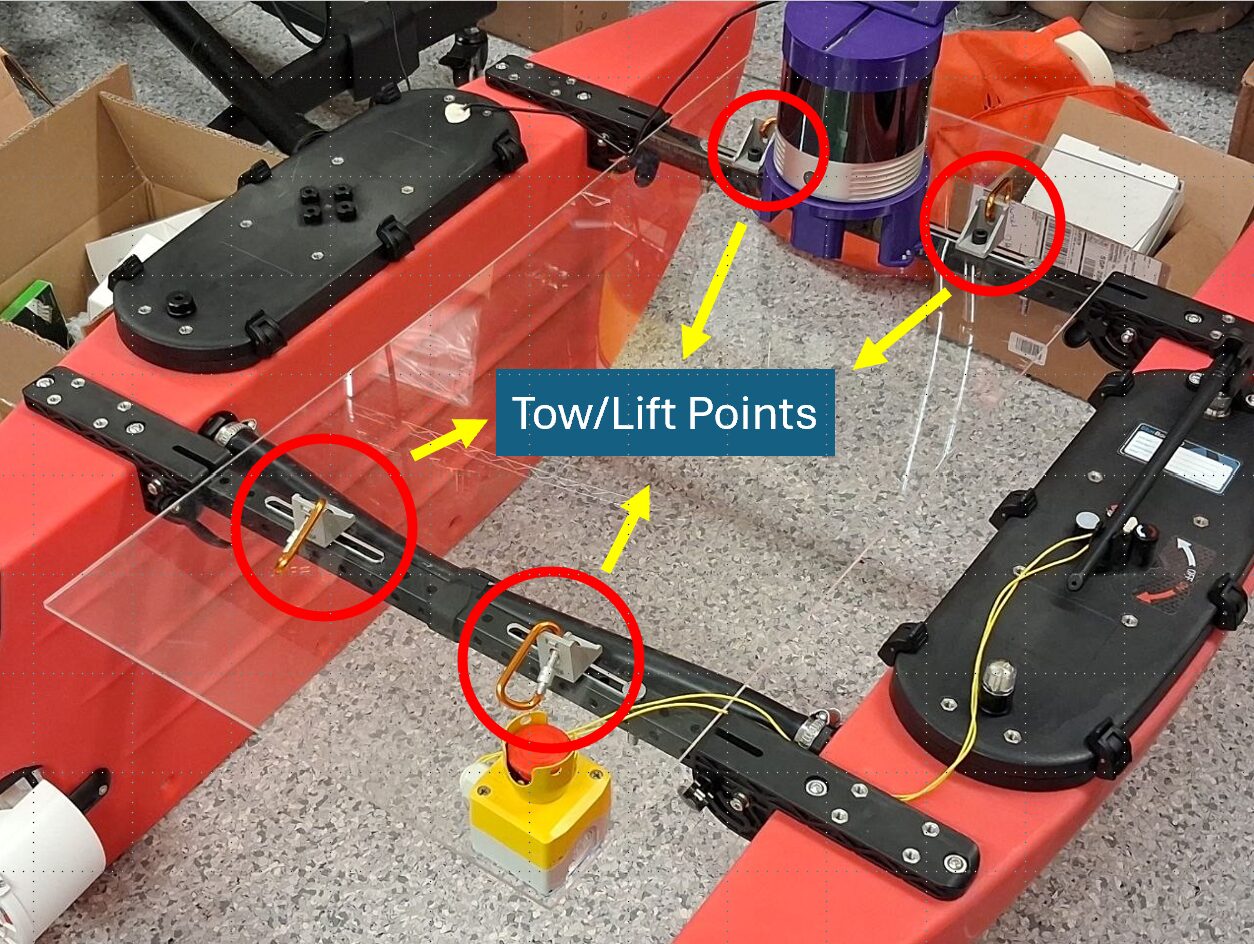
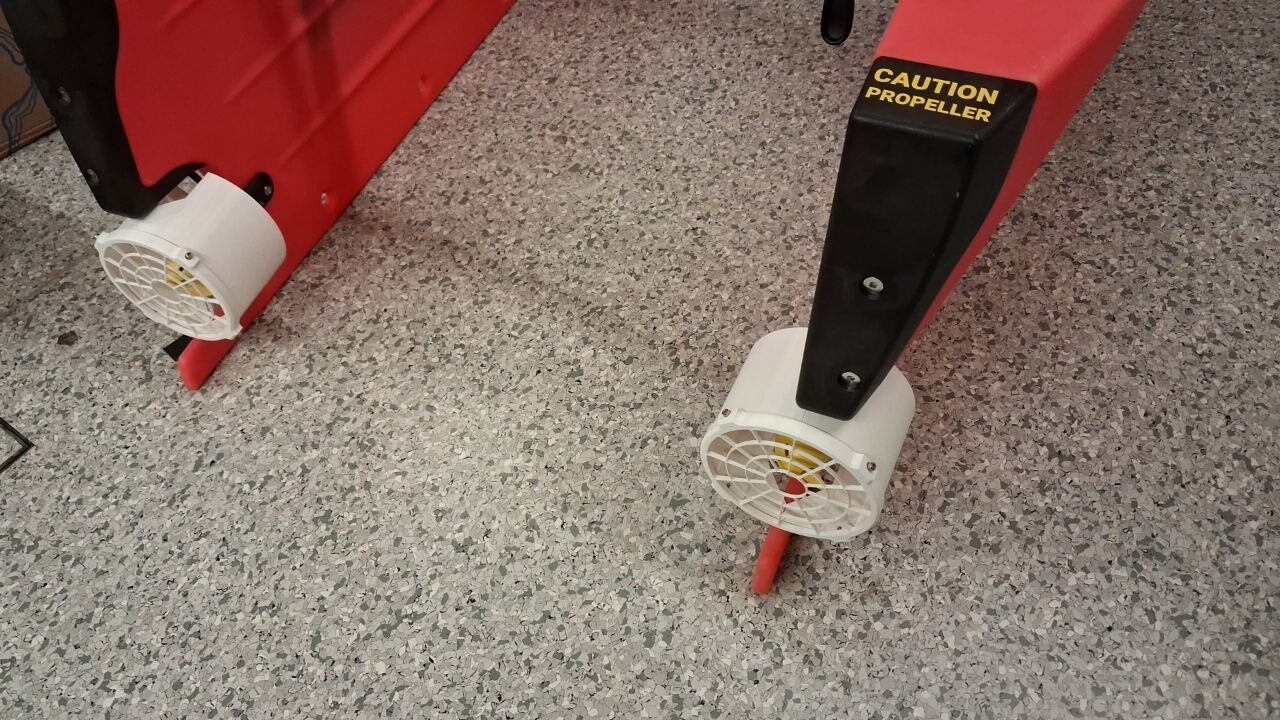
Section 5.2 of the handbook lists the safety equipment a surface vessel has to carry. The table shows how the boat meets each item.
| Requirement | On the boat |
|---|---|
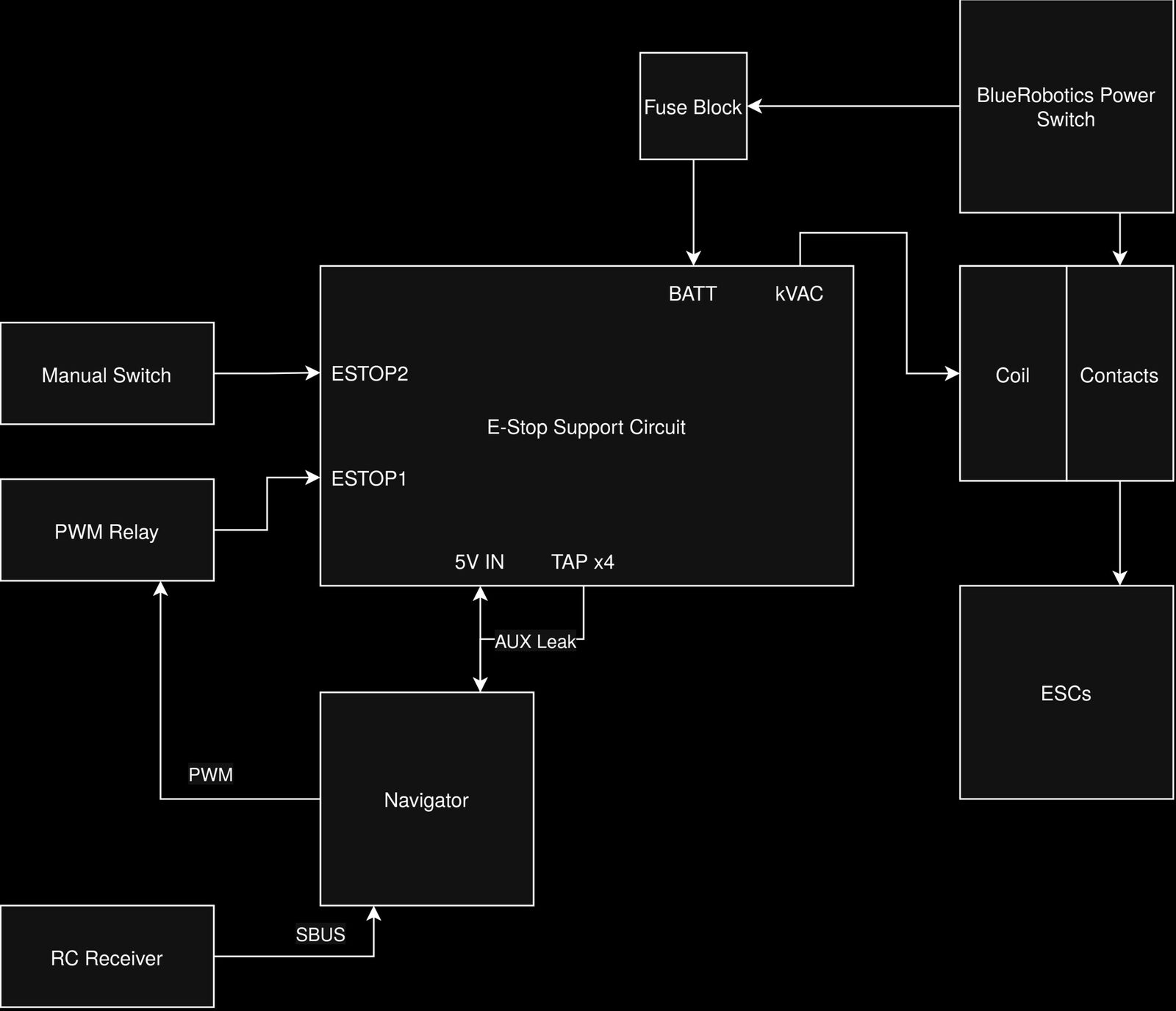
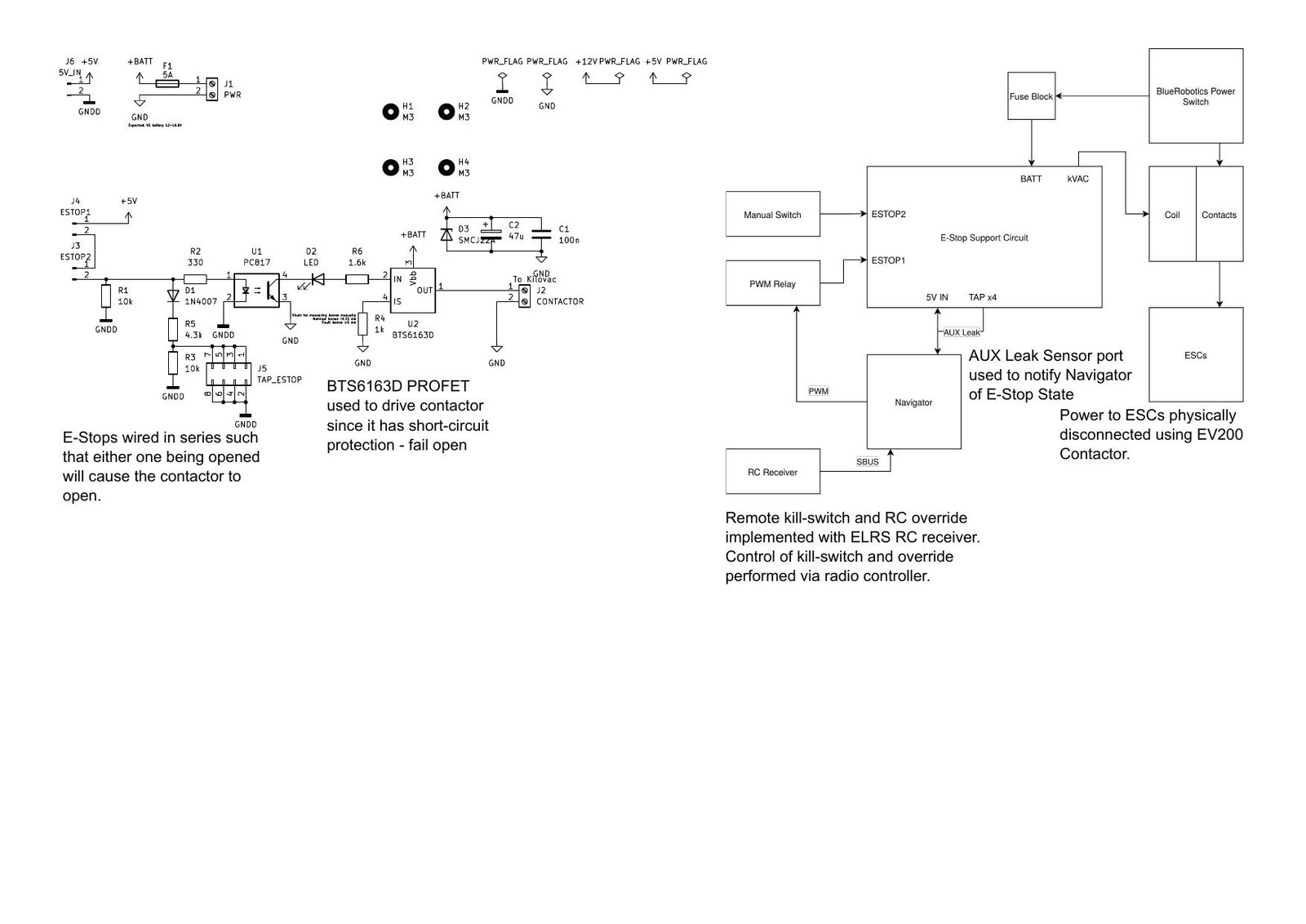
| Onboard and remote kill switches, fail safe, red, 3 cm or larger | Mushroom head switch on the cross member and a wireless stop that cuts propulsion power within two seconds |
| Shrouded propellers, 5 cm clearance or a finger guard | Printed shrouds over both thrusters, each labelled |
| Marked multi-point tow harness and lift points | Four marked points on the frame with a matching harness |
| Visual feedback showing kill, manual and autonomous | Mast light visible through 360 degrees in daylight |
| Manual control independent of a laptop | Dedicated transmitter and receiver, documented in the block diagram below |
Autonomy
The ground station holds the boat in GUIDED and sends position targets. The safe passage transit and the dock approach are both sequences of these targets. Arming goes through ArduPilot's prearm checks with a retry, because a GPS prearm failure is the most common problem on this hull, and the retry usually clears it in about thirty seconds.
Under rule 5.1, leaving autonomy ends scoring for the attempt. The console therefore treats a manual takeover as an abort: the run is marked not scoring and the operator sees this in the header.
Task 3 adds a dock approach that places the hull inside a bay, and a water jet aimed at a 25 cm window. Both run from the same task state machine as the other tasks, with one step per action, so a suspension during the dock approach resumes at the step it stopped on.
Perception
The buoy detector is a YOLOv5s model trained on the MHSeals set, at 0.945 mAP@0.5 and 0.693 mAP@0.5:0.95 over 27 classes. The colour classes apply directly to the 2026 light beacons. The shape classes do not, because the 2026 buoys carry lights instead of shapes.
Camera to lidar fusion from the lab's earlier work has about 8 cm of range error and a systematic 8 to 9 cm lateral and vertical bias. The passage transit planning uses this figure as its position uncertainty.
Evidence
The boat under autonomous control, with the status light showing the current mode. Submitted as part of the surface vehicle readiness package.
The full readiness package, including the kill switch drawings and the harness photographs, is listed on the proof of readiness page.