Vehicles / BlueROV2
BlueROV2
The underwater vehicle. It surveys the pipeline in Task 2 and repairs the damaged node with a magnetic probe. It has no position source underwater, which shaped how it is controlled.
The platform
The vehicle is a BlueROV2 in the heavy configuration, with six thrusters, an ArduPilot Sub autopilot, and a Raspberry Pi running BlueOS that carries video and MAVLink up the tether. The autonomy stack connects on one UDP endpoint and a pilot keeps QGroundControl on another, so the pilot can take over at any time without stopping the autonomy stack.
- FrameBlueROV2, 0.46 m, six thrusters
- AutopilotArduPilot Sub
- CompanionRaspberry Pi, BlueOS at 192.168.2.2
- Autonomy endpointudpin 14551
- Pilot endpointudpin 14550, QGroundControl
- CameraRTSP H264, 1280x720 at 15 fps
No position underwater
ArduSub rejects GUIDED and POSHOLD with "requires position" whenever the filter has no position estimate. In software in the loop this clears about a minute after boot, once the filter starts using GPS. On the real vehicle underwater it never clears, because a BlueROV2 without a Doppler velocity log or an acoustic positioning system has no absolute position source.
Adding either sensor was outside the budget, so the ground station treats depth hold as an autonomous mode for this vehicle only. The adapter requests GUIDED first, falls back to depth hold when arming, and drives the vehicle with body frame velocity commands. The autopilot closes the depth loop, which is the one axis it can hold without a position estimate.
Consequences
The survey is flown on heading and time instead of on waypoints, so the pipeline has to be found again by camera after each turn. In return the vehicle can run autonomously with the hardware it has now, and does not depend on a sensor that may not arrive before the event.
Control interface
The adapter sends two kinds of command to the vehicle.
| Command | What it does | Used for |
|---|---|---|
| VELOCITY | Body frame velocity with yaw rate, in depth hold | The normal autonomy path: transit, survey, station keeping |
| RC_OVERRIDE | Writes the same channels a pilot's transmitter writes, 1500 neutral, 1100 to 1900 full scale | Fine positioning on the pipeline, and handing the vehicle back to a pilot mid-run |
Channels not named in an override keep the pilot's stick values instead of being zeroed. This lets the pilot take over on the controller without the autonomy commands working against them.
Pipeline survey and repair
Task 2 starts at the buoy with the green indicator, which has the active pinger below it. The vehicle descends, finds the pipeline, and reports each of the five segments as intact or damaged, working from that end. The damaged segment has a red light ring with a magnetic switch at its centre. Holding the probe on the switch turns the light green.
At Advanced the repaired node then flashes a colour for thirty seconds to name the resource it needs. The vehicle sends that request to the aircraft and reports completion to RoboCommand. At Disruptive the node flashes two colours, the first naming the tin and the second naming the delivery circle, and the request carries both.
Safety systems
- Onboard kill switch. The vehicle is positively buoyant when killed, so it surfaces.
- Status light readable at about 80 m while surfaced, showing kill, manual and autonomous.
- Marked tow and lift points with a harness.
- A dedicated mounting location for the RJE ULB-350 locator beacon the event issues before any underwater vehicle enters the water, mounted vertically with the end cap down.
- Tether to the boat kept positively buoyant, under 6 m, and strong enough to recover the vehicle by pulling on it.
During a scoring run nothing attached to the vehicle may float on the surface, and the vehicle must not breach. For this reason depth hold is armed before the run starts, not after the first transit.
Evidence
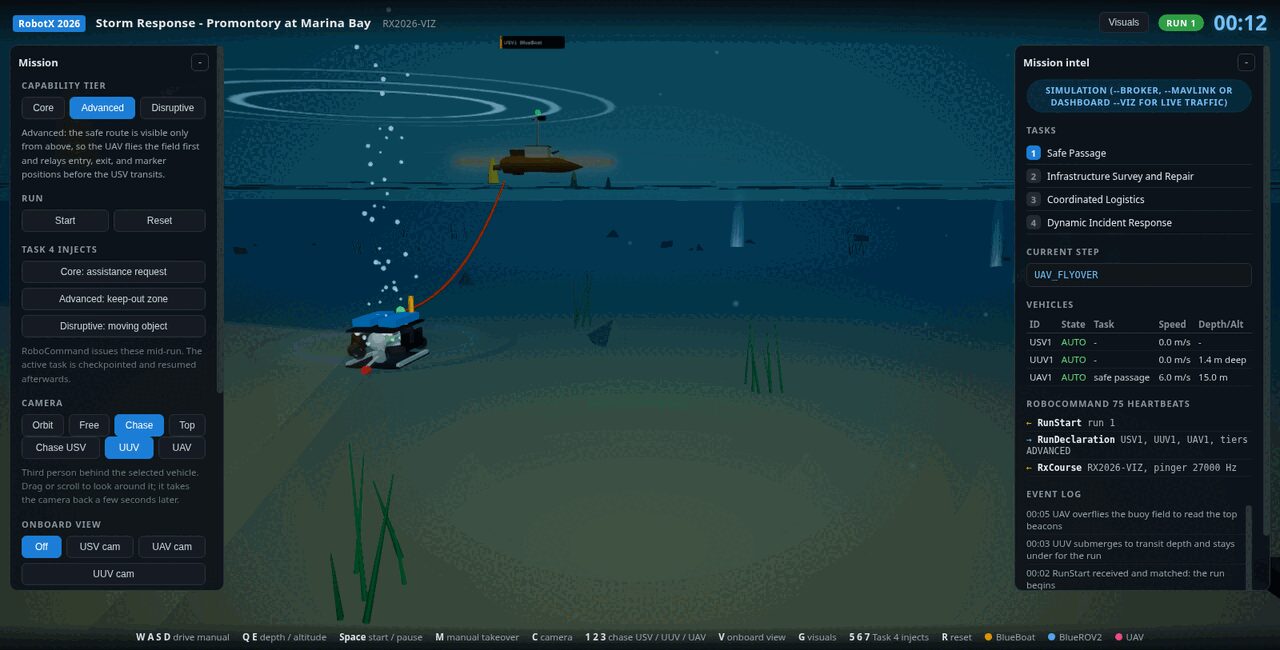
The 3.1.3 course run in our simulator. The vehicle starts 3 m behind the gate, submerges, passes under the 2 m gate inside its width, circles the marker 10 m beyond it and returns. Depth and clearance are checked against the handbook criteria as it runs. The vehicle stays more than 0.3 m below the surface throughout.