Simulation
The mission is run in software before it is run on hardware. The autopilot firmware runs software in the loop behind an emulated radio link, and a model of the Marina Bay course is built from the dimensions in the handbook.
Course simulator
This is the scene the team rehearses with, running in the browser. It starts paused. Press start, then use the camera buttons to follow a vehicle, or trigger one of the Task 4 interruptions to see how the mission resumes.
Simulation layers
There are four layers. Each one answers a different question, and each runs on a laptop.
| Layer | Answers | Cost to run |
|---|---|---|
| Python vehicle models | Does the mission logic work? Deterministic and instant, used by the test suite. | seconds |
| ArduPilot software in the loop | Does the real firmware accept what we send it? Prearm checks, filter convergence, mode changes, failsafes. | 2 s to boot the fleet |
| HaLow link emulator | Does the mission still work over a radio link with packet loss and fades? | in line with the above |
| Course model in the browser | Does the plan work on the course layout, and can a judge or a teammate view it? | a browser tab |
Software in the loop
Software in the loop runs the same firmware the vehicles run, compiled for the laptop: ArduRover with a motorboat model for the BlueBoat, ArduSub with a vectored model for the ROV, and Copter with a quad model for the aircraft. The arming checks, filter convergence, guided navigation and failsafes are the firmware's own.
Between the firmware and the ground station is an emulator for the WiFi HaLow link. It adds fixed latency and jitter, random loss, a bandwidth cap and periodic outages.
| Profile | Behaviour |
|---|---|
| perfect | No impairment. Used for tests that are not about the link. |
| halow_near | Short range, low latency, occasional loss. |
| halow_typical | The link expected on the course. |
| halow_fringe | 60 ms of latency with 40 ms of jitter, 8 percent loss, 300 kbps, and a two second fade every 25 seconds. |
Under the fringe profile the health monitor escalates to an emergency stop on heartbeat loss, which is the intended behaviour. Testing under this profile is also why the adapter now requests only the telemetry it uses instead of ArduPilot's default stream set.
Course model
The course objects are built from the handbook's build specifications, in metres: ten buoys with side and top light beacons, the pair of survey buoys with their colour indicators and pingers, a five section pipeline on stands with five magnetic light nodes, three docking bays with their windows and indicators, two 2 m delivery platforms with 65 cm circles in the specified colours, and the launch pad. Marina Bay Sands, the ArtScience Museum, the Singapore Flyer and the Helix Bridge are included as landmarks, since they are what the operator sees from the course.
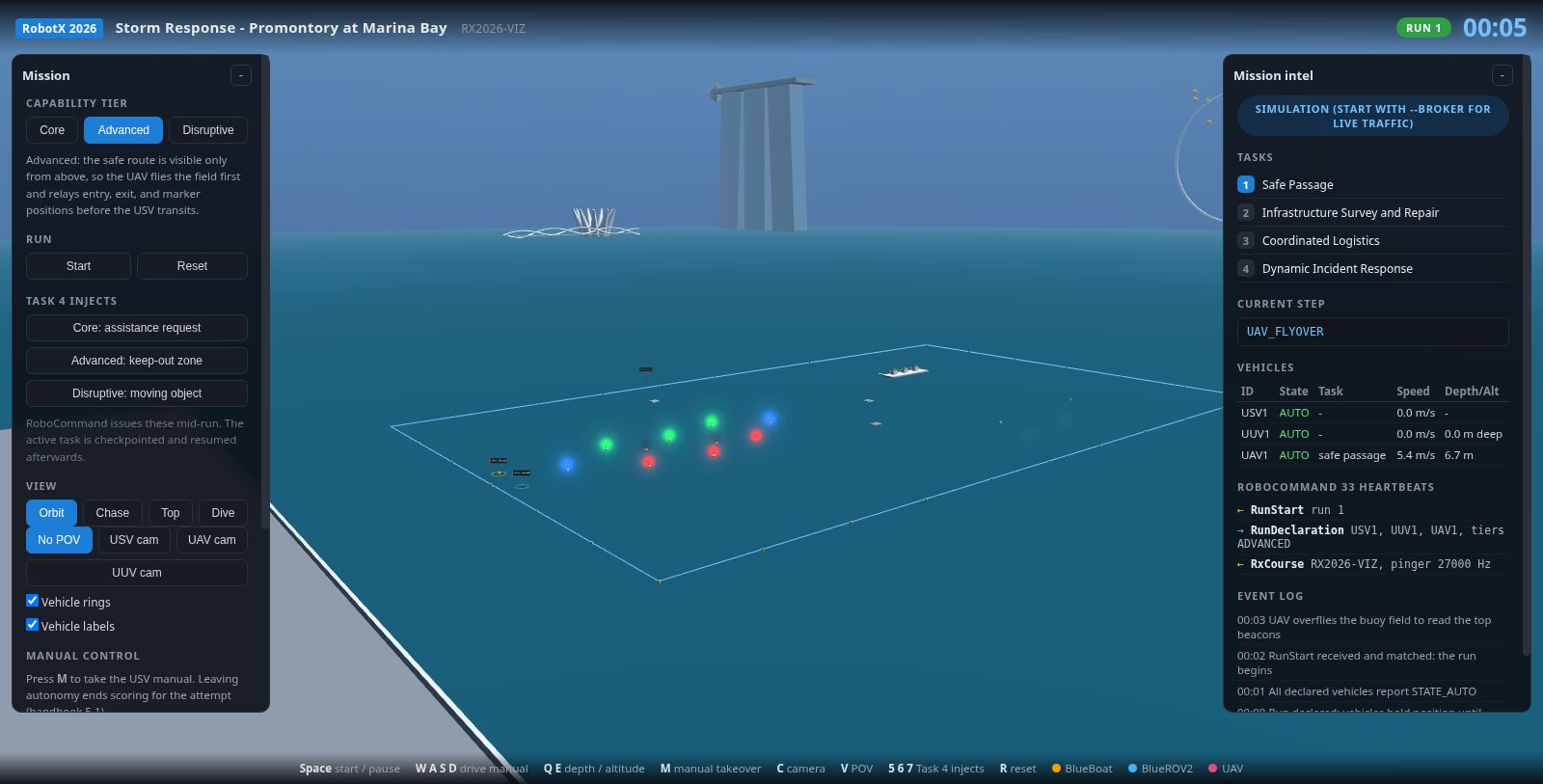
A full safe passage attempt at Advanced. The aircraft flies the buoy field first, because at this tier the route is only visible from above, and relays the route to the boat. The boat circles the entry buoy and transits. The panel on the right shows the RoboCommand messages the real link would carry.
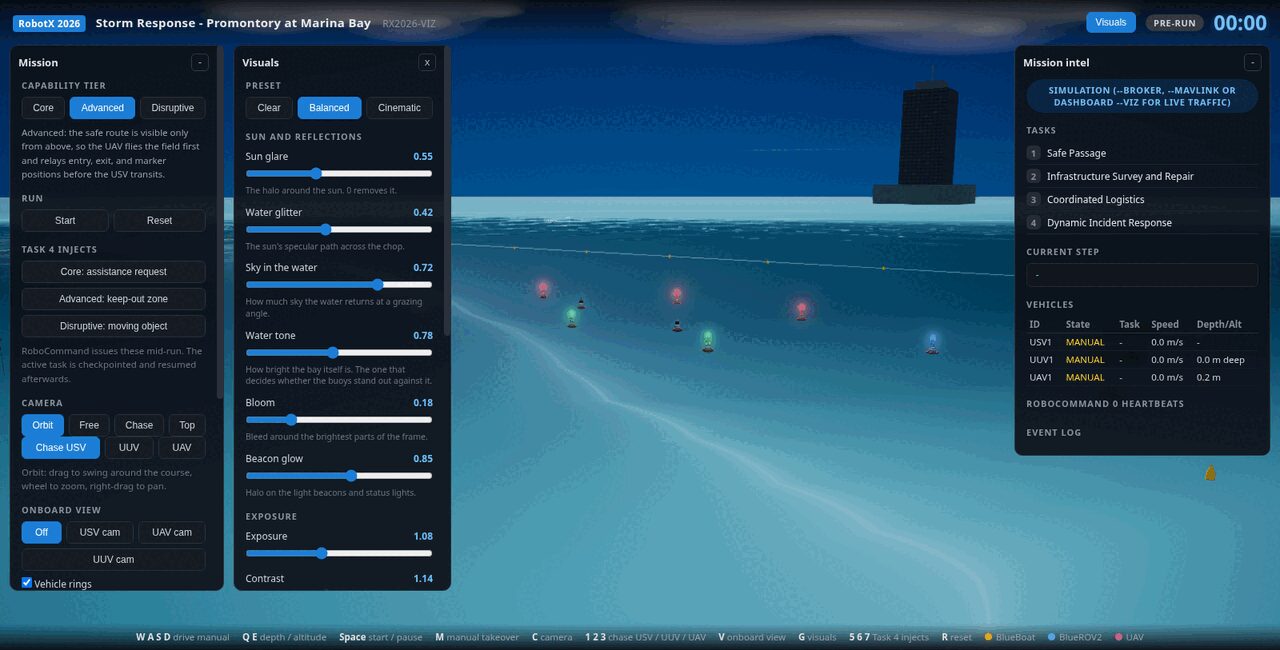
The ROV at transit depth with the tether running up to the boat. The water is rendered opaque because Marina Bay is a working harbour, and a camera above the surface would not see the vehicle.
The same scene has three other modes. It can show live RoboCommand traffic from a broker, read MAVLink telemetry from a vehicle or a software in the loop fleet, or be served by the running ground station so the terminal console and the browser show the same mission.
End to end validation
One command launches the fleet, runs a full scripted mission against it and prints a pass or fail table of 25 checks. The sequence runs from a cold start to a stop: fleet ready with position, the pre-run gate, the course configuration and run declaration, arming against real prearm checks, run start, takeoff, task dispatch, buoy circling and the passage transit under guided navigation, an assistance request arriving mid transit, the checkpoint, the incident response with its acknowledgement on the wire, resume from the checkpoint, the safe passage report, task and mission completion, return to launch, and an emergency stop that disarms everything.
The exit code is used in continuous integration, so a change that breaks the mission fails the build.
The browser scene is checked the same way. A headless test builds the scene without a display, runs the mission, and fails if a task does not complete, if the expected RoboCommand messages do not appear in order, if a chase camera loses its vehicle, or if the underwater chase camera comes above the surface.
What is simulated
Real components
The autopilot firmware, its arming and failsafe logic, the MQTT broker, the protocol buffer schema from the competition release, the message rates, and the ground station. The same program drives the simulated fleet and the hardware.
Simplified or missing
Vehicle dynamics are limited to the firmware's own models. Waves, current and cameras are not modelled. Perception cannot be tested in this setup, so the detector work is tested on recorded footage.
Planned work
Two additions are planned. Tasks 2 and 3 will get their own validation scenarios, so the pipeline follow and the dock approach are tested the same way as the safe passage. After that, a Gazebo world with the course props would add simulated cameras and disturbances, which perception in the loop testing needs.
Photorealistic underwater rendering in Isaac Sim was evaluated and not adopted. The lab's current graphics card is not supported by the versions with the underwater features, and the mission logic does not need it.